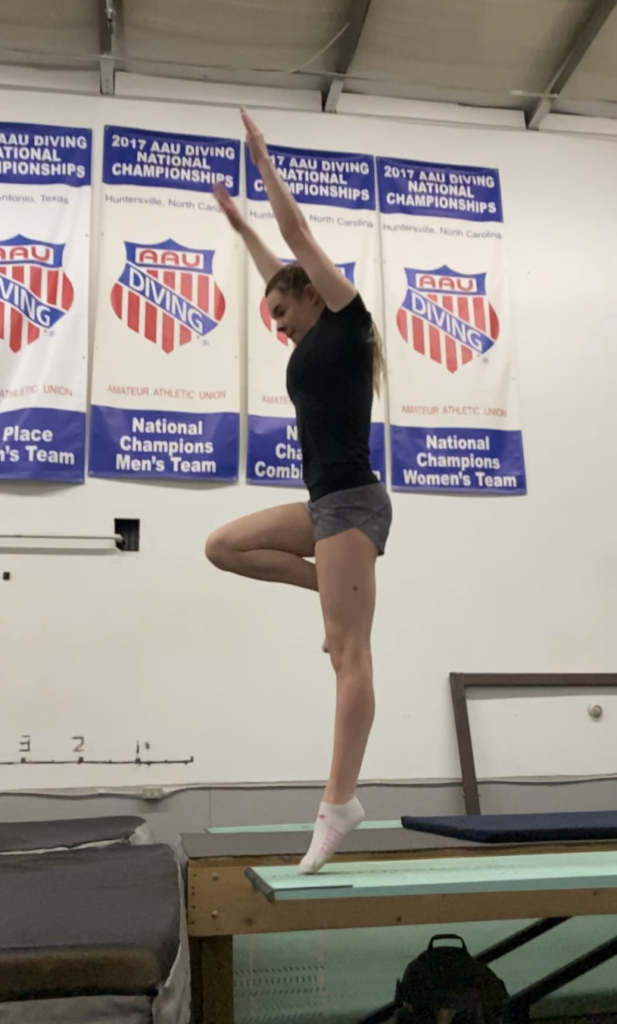
Gymnasts Make Great Divers
Turn your child’s gymnastics experience into a new opportunity in springboard diving.
The strength, flexibility, coordination, body awareness, and flipping skills developed in gymnastics provide an outstanding foundation for diving.
Gynmnasts must be able to swim 20 yards independently in deep water.
A New Sport That Builds on Skills Your Child Already Has
Leaving gymnastics can be a difficult transition. Your child may miss the movement, challenge, friendships, and satisfaction of mastering new skills.
Springboard diving offers a new place to use many of the abilities developed through gymnastics.
Instead of starting over, former gymnasts often discover that they already understand many of the physical concepts used in diving. They can build upon years of training while learning an exciting new sport.
Why Gymnastics Transfers So Well to Diving
Body Awareness
Gymnasts understand where their bodies are while jumping, rotating, and moving through the air.
Flexibility
Shoulder, back, hip, and leg flexibility help divers create strong positions and clean lines.
Strength
Core strength and overall body control provide an excellent foundation for springboard skills.
Skill Transfer
Gymnasts are already familiar with tuck, pike, straight, twisting, and somersaulting movements.
Coachability
Gymnasts understand how to listen to corrections, repeat drills, and work progressively toward difficult skills.
Courage and Resilience
Learning gymnastics requires courage and resilience. Those qualities transfer directly to diving.
Different Sport, Familiar Skills
Diving and gymnastics have important differences. Divers must learn how to use the springboard, control takeoffs, spot the water, and enter safely.
Upstate coaches do not assume that a gymnast automatically knows how to dive. We identify the skills your child already possesses and then teach the diving-specific techniques needed to use those skills successfully.
Former gymnasts may progress quickly, but safety and fundamentals remain the priority.
Recreational and Competitive Opportunities
Not every former gymnast wants another intensive competitive commitment.
Upstate Diving offers different pathways. Your child may participate recreationally, prepare for middle school or high school diving, or work toward regional and national competition.
Our coaches will help your family choose a level of commitment that matches your child’s interest and goals.
A Complete Training Environment
Upstate’s training system allows former gymnasts to learn diving skills both in and out of the water.
Depending on program placement, divers may use:
- One-meter and three-meter springboards
- Dryland diving boards
- Trampolines
- Overhead spotting equipment
- Training mats
- Video replay
- Strength and flexibility training
- Structured skill progressions
This environment is especially valuable for gymnasts because it allows familiar movements to be adapted gradually to diving.
What Happens at a Trial Class?
A trial class allows your child to experience Upstate Diving before selecting a regular membership.
During the trial, your diver will:
- Meet an Upstate coach.
- Learn basic safety expectations.
- Try age-appropriate introductory skills.
- Experience the pool and diving boards.
- Receive a recommendation for the appropriate group and schedule.
For a pool trial, bring a swimsuit and towel.
Divers do not need goggles.
Required sports-insurance registration must be completed before participation. We will provide the current instructions after receiving your trial request.
What Happens at the First Session?
At the first session, an Upstate coach will:
- Discuss your child’s gymnastics background.
- Evaluate basic jumping, body-position, and movement skills.
- Introduce diving-specific safety and technique.
- Allow your child to experience appropriate pool or dryland activities.
- Recommend the best training group and schedule.
Your child does not need to prepare a routine or demonstrate advanced gymnastics skills.
Starting Is Simple
1. Tell Us About Your Diver
Complete the short trial-request form.
2. Receive a Class Recommendation
We will help you select the most appropriate location and beginner practice.
3. Meet Your Coach
Attend the confirmed trial class and let your child experience springboard diving.
Frequently Asked Questions
Does my child need competitive gymnastics experience?
No. Recreational, school, and competitive gymnastics experience can all provide useful transferable skills.
What if my child has been away from gymnastics?
That is not a problem. Coaches will evaluate your child’s present readiness rather than expecting a particular skill level.
Will my child have to begin with complete beginners?
Placement depends on age, experience, current skills, and diving-specific readiness. Some former gymnasts begin in Learn to Dive, while others may be placed in a developmental group.
Does my child have to compete?
No. Recreational and school-diving pathways are available. Competition-team placement is based on interest, readiness, and coach recommendation.
Is diving easier than gymnastics?
Diving uses many familiar abilities, but it is a different sport with its own technical and mental challenges. Gymnastics experience gives your child a strong foundation rather than an automatic shortcut.
Where does Upstate train?
Programs are offered at RIT in Rochester, in Canandaigua, and at Upstate’s specialized dryland facility. Placement and availability determine the appropriate location.
What should my child bring?
For a pool session, bring a swimsuit and towel. Divers do not need goggles. We will provide any additional instructions before the first session.
Your Child’s Gymnastics Experience Can Become a New Beginning
The strength, flexibility, discipline, and courage developed through gymnastics do not have to be left behind.
Springboard diving gives your child a new way to use those abilities, master exciting skills, and become part of a supportive team.